
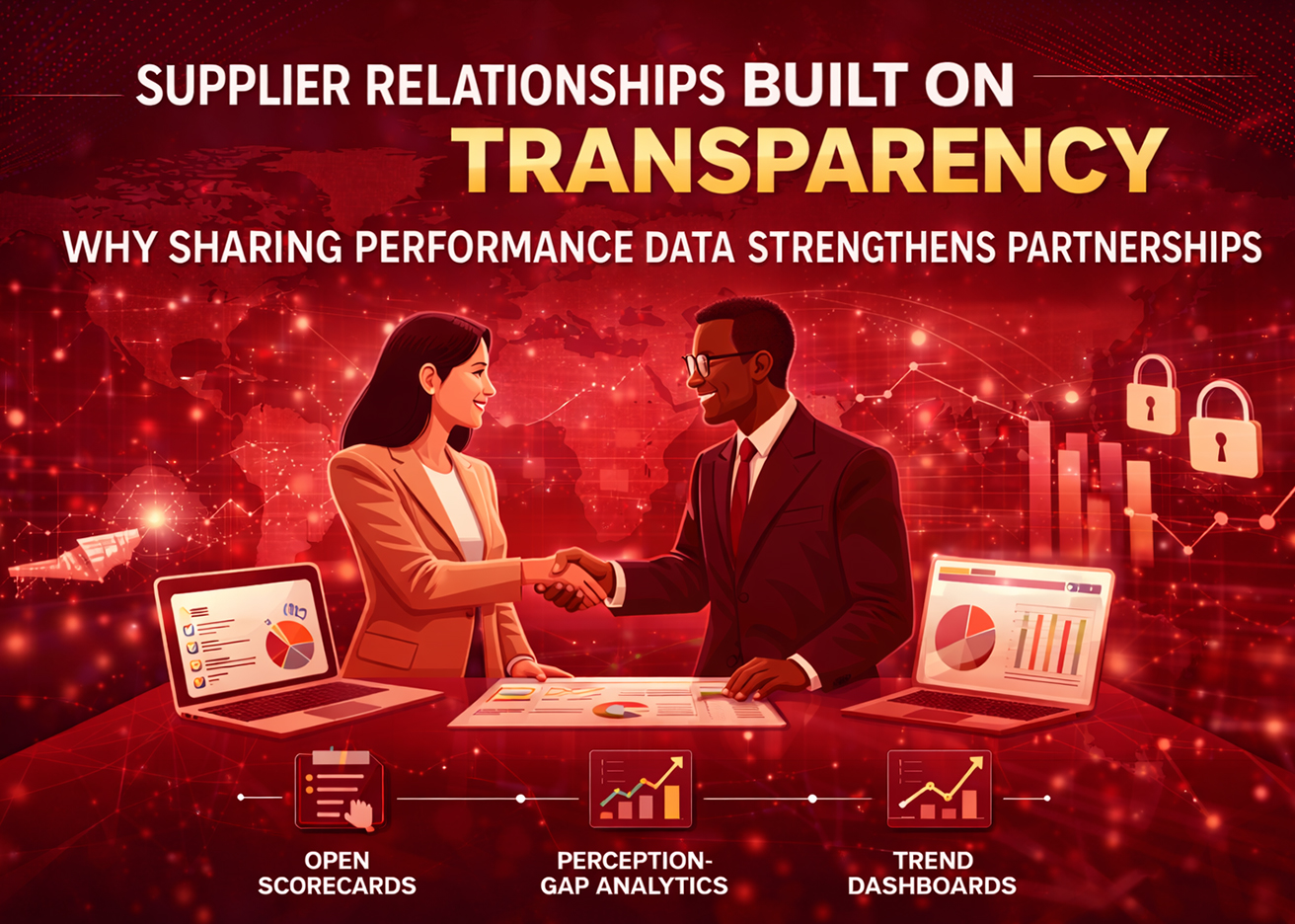
Supplier Relationships Built on Transparency: Why Sharing Performance Data Strengthens Partnerships
For decades, supplier performance data lived behind closed doors. Procurement teams collected it, analyzed it internally, and shared only carefully selected snapshots during quarterly or annual business reviews.
- Suppliers saw only what procurement chose to reveal
- Feedback was filtered, delayed, or softened
- Underperformance issues surfaced months later
- Trends and context were hidden behind isolated KPIs
This traditional approach created supplier relationships built on partial information rather than mutual understanding.
Modern supply chains demand something better. They demand transparency.
Sharing performance data openly—through scorecards, dashboards, qualitative feedback, trend analysis, and perception-gap insights—is now one of the most effective ways to strengthen supplier relationships and accelerate improvement.
Transparency is not risky. Transparency is not confrontational. Transparency is collaborative.
When suppliers see what buyers see, misunderstandings decrease, alignment improves, and both sides work more effectively toward shared goals.
Platforms like SupplyHive enable this by giving suppliers visibility into:
- Performance scores
- Stakeholder sentiment
- Trends over time
- Perception gaps between buyer and supplier
- Qualitative feedback themes
- Category benchmarks
- Development opportunities
This level of clarity transforms supplier relationships from guarded to genuinely strategic.
Why Transparency Is the Missing Ingredient in Supplier Relationships
One of the biggest reasons supplier performance fails to improve is simple: suppliers don’t know what the buyer actually experiences.
- They find out too late
- Only through escalations
- In vague or non-specific language
- Or during defensive annual reviews
When suppliers operate in the dark:
- Issues repeat
- Misunderstandings grow
- Trust erodes
- Improvement slows
- Perception gaps widen
- Both sides become reactive instead of proactive
Transparency fixes this by making performance data accessible, understandable, timely, actionable, and shared.
This shifts supplier management from a policing model to a partnership model.
What Transparency Really Means in Modern Supplier Relationship Management
Transparency in SRM is not about exposing faults or increasing pressure. It means:
Sharing Real Performance Data
Suppliers see actual KPI scores as they evolve, not filtered summaries.
Sharing Multi-Stakeholder Feedback
Operations, finance, engineering, and end-users contribute insights suppliers rarely hear directly.
Sharing Qualitative Context
Structured comments and themes explain the story behind the numbers.
Sharing Perception-Gap Insights
Suppliers see where their self-assessments align—or misalign—with buyer evaluations.
Sharing Trends and Patterns
Suppliers understand how performance changes over time, not just isolated outcomes.
Sharing Segmentation and Expectations
Suppliers know how they are classified and what improvement looks like.
Transparency turns the relationship into a two-way conversation, not a one-way evaluation.
The Psychological Impact of Transparency on Supplier Behavior
Behavioral science shows people perform better when they understand expectations, measurement criteria, current standing, and success definitions.
Motivation
Clear, consistent performance data increases accountability and urgency. When improvement is measurable, it becomes meaningful.
Trust
Transparency signals fairness. Suppliers trust buyers more when nothing is hidden and feedback is timely, structured, and consistent.
Alignment
When suppliers clearly see what buyers value, ambiguity disappears and focus increases.
Why Sharing Performance Data Accelerates Supplier Improvement
Suppliers cannot improve what they cannot see. Shared performance data removes guesswork.
Faster Root Cause Understanding
Qualitative insights and sentiment analysis explain why scores exist, not just what they are.
Visibility Into Trends
Patterns and recurring themes help suppliers identify systemic issues instead of reacting to one-off complaints.
Recognition of Perception Gaps
Comparing self-scores with buyer evaluations highlights blind spots that drive real change.
More Honest Conversations
Specific, data-backed feedback replaces vague commentary and unlocks action.
Higher Supplier Engagement
Shared dashboards encourage ownership, accountability, and continuous improvement.
How SupplyHive Enables Transparency That Builds Strong Partnerships
- Shared Scorecards: Suppliers see the same KPIs as buyers
- Multi-Stakeholder Visibility: Insights from across the organization
- NLP & Sentiment Analysis: Feedback organized into actionable themes
- Trend Dashboards: Real-time progress tracking
- Perception-Gap Comparisons: Clear visibility into blind spots
- Segmentation Insights: Clear expectations and pathways to improvement
- Objective Scoring: Consistent, fair evaluations
Why Transparency Strengthens Supplier Relationships
Many buyers fear transparency will create tension. In reality, suppliers prefer clarity.
Transparency builds trust, fairness, accountability, alignment, and collaboration because both sides see the same data and reasoning.
Transparency doesn’t damage relationships. It strengthens them.
The Bottom Line: Shared Data Creates Shared Success
When suppliers clearly understand how they are performing—and why—improvement becomes a shared journey rather than a buyer-only expectation.
Transparency leads to stronger alignment, better communication, faster improvement cycles, reduced friction, and more strategic partnerships.
Conclusion: The Future of Supplier Relationships Is Transparent and Collaborative
Supplier relationships built on transparency consistently outperform those built on selective disclosure.
With open scorecards, shared dashboards, perception-gap analytics, and structured feedback, procurement teams can strengthen trust, increase accountability, and accelerate improvement.
Suppliers don’t want less data. They want fair, timely, and actionable data.
Transparency is not a risk. It is a competitive advantage.
And with SupplyHive, transparency becomes a core part of every supplier relationship.