
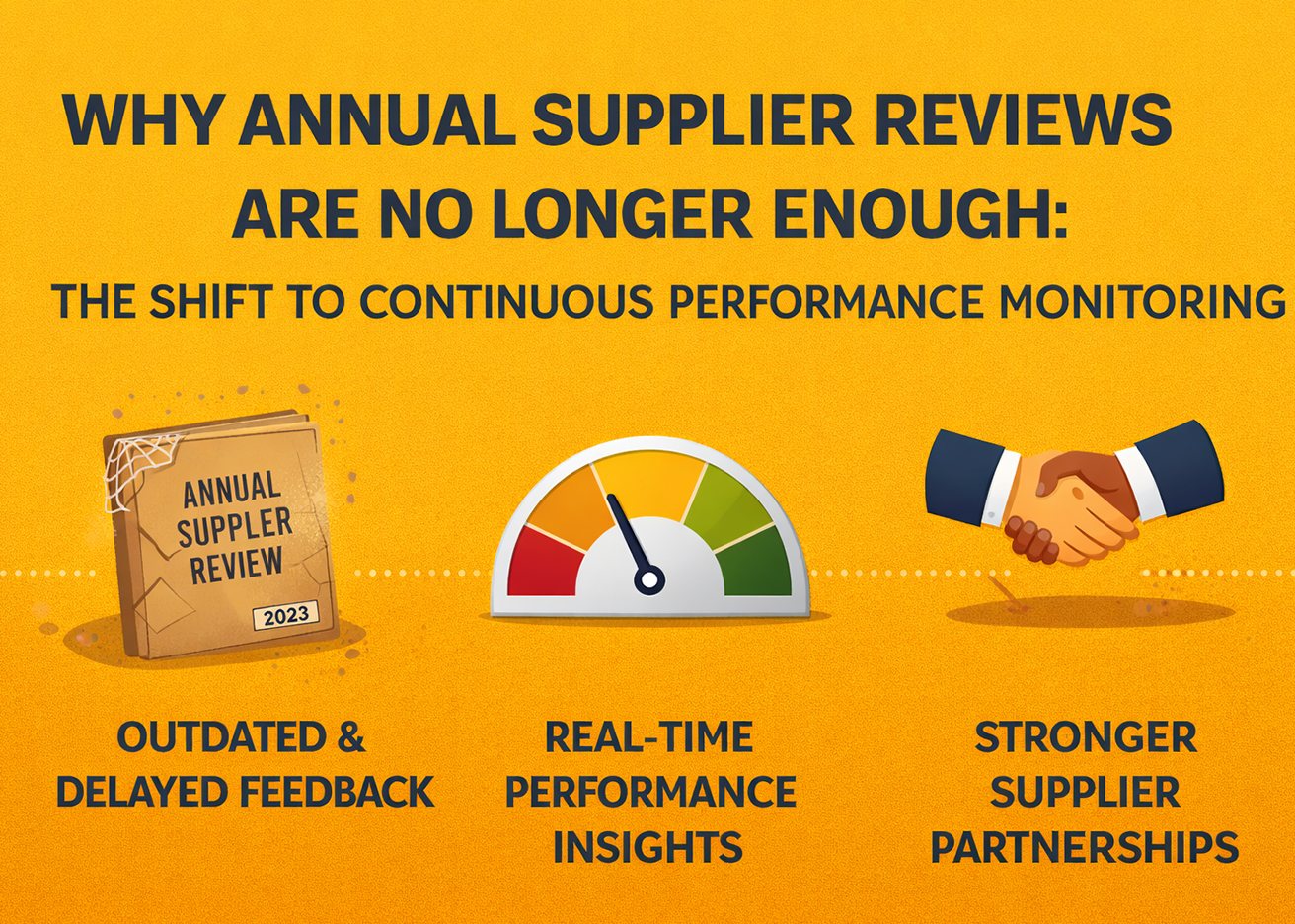
Why Annual Supplier Reviews Are No Longer Enough: The Shift to Continuous Performance Monitoring
For decades, annual supplier reviews were the standard. Once a year, procurement teams gathered data, reviewed KPIs, held a formal meeting with suppliers, and documented strengths and weaknesses. It was structured, predictable, and easy to manage.
But the world has changed. Supply chains have changed. And supplier relationships have changed.
A supplier who performs well in Q1 may struggle in Q3. A single isolated issue may unfairly define an entire year. Critical problems can emerge suddenly, while opportunities for collaboration or innovation can be missed entirely.
Most importantly, the pace of modern business has made annual feedback dangerously outdated.
Today, organizations need continuous performance visibility, not a once-a-year snapshot. They need real-time insights, multi-stakeholder feedback, and transparent conversations that help suppliers improve faster and more effectively.
This is why organizations are shifting from annual reviews to continuous Supplier Performance Management (SPM), and why platforms like SupplyHive are redefining what supplier monitoring looks like.
The Problem With Annual Supplier Reviews: Too Slow and Too Shallow
Annual reviews are a legacy process designed for a time when supply chains were simpler, disruptions were rare, and supplier expectations were lower.
Modern supplier relationships are dynamic. Performance fluctuates. Risks appear suddenly. Stakeholder experiences evolve continuously.
Here’s where annual reviews fall short.
They Miss Early Warning Signs
If delivery issues start in February but the review happens in December, teams struggle for months before the supplier even hears about it.
This leads to escalations, lost productivity, costly workarounds, avoidable tension, and damaged trust. By the time feedback is shared, the damage is already done.
They Encourage Defensive Behavior Instead of Improvement
Annual reviews compress all feedback into one high-pressure meeting. Suppliers often feel blindsided, become defensive, and focus on explaining the past rather than improving the future.
Continuous feedback enables small, manageable course corrections that are far easier to act on.
They Fail to Capture Real Stakeholder Experiences
Annual reviews typically reflect procurement’s perspective alone.
Operations may face daily delays. Engineering may struggle with documentation. Finance may be correcting invoice errors weekly. These realities often never surface in annual reviews.
They Rely on Memory Instead of Data
Annual reviews depend on recalling what happened months ago, why it happened, and how people felt.
Memory-based evaluations are subjective and incomplete. Continuous, data-driven insights eliminate guesswork.
They Reinforce a Compliance Mindset
When performance is assessed once a year, suppliers focus on passing the review rather than improving consistently.
Continuous monitoring encourages a growth mindset and healthier performance behaviors.
Why Continuous Performance Monitoring Is the New Standard
Modern supply chains are too volatile for delayed evaluations. Procurement teams need a steady flow of insights, not periodic snapshots.
Faster Identification of Problems
Ongoing feedback flags issues such as communication breakdowns, quality inconsistencies, late shipments, documentation errors, and responsiveness gaps early.
Suppliers can correct problems before they escalate.
Real-Time Trends Reveal True Performance
Continuous monitoring shows whether performance is improving or declining, highlights seasonal fluctuations, uncovers recurring patterns, and tracks sentiment shifts.
A trend tells a far richer story than a single score.
Keeps Suppliers Engaged All Year
When suppliers know performance is monitored fairly and transparently, they respond faster, stay aligned, take ownership, and participate more actively in improvement efforts.
Improves Cross-Functional Alignment
Ongoing input from operations, finance, engineering, and end-users ensures no team is unheard and supplier impact is understood holistically.
Procurement decisions become better informed and less isolated.
Eliminates Surprises in Reviews
Continuous monitoring replaces tense annual meetings with open dialogue, shared expectations, transparency, trust, and collaboration.
How SupplyHive Enables Continuous Supplier Performance Monitoring
SupplyHive makes continuous monitoring practical, structured, and relationship-focused.
Frequent Multi-Stakeholder Reviews
Feedback can be collected quarterly, monthly, project-based, event-based, or on demand—creating constant visibility.
Real-Time Scorecard Metrics
Configurable KPIs track delivery, quality, responsiveness, innovation, service, and cost adherence as performance evolves.
NLP and Sentiment Analysis
Shifts in frustration or praise are detected early, enabling proactive intervention.
Perception-Gap Analytics
Supplier self-evaluations are compared with buyer scores to reveal alignment gaps and relationship changes over time.
Trend Dashboards
Performance trajectories, consistency, recurring issues, and improvement signals are displayed clearly for action.
Dynamic Supplier Segmentation
Suppliers move segments automatically as performance changes, keeping classifications current and meaningful.
How Continuous Monitoring Strengthens Supplier Relationships
Contrary to outdated beliefs, continuous evaluation strengthens relationships rather than straining them.
It creates transparency, reduces surprises, supports incremental change, ensures suppliers feel heard, and builds trust through honest, ongoing dialogue.
Partnership replaces policing.
Why Quarterly or Real-Time Feedback Outperforms Annual Reviews
- Annual reviews rely on memory; continuous monitoring relies on fresh data
- Annual reviews reflect one perspective; continuous monitoring includes many
- Annual feedback is delayed; continuous signals are immediate
- Annual reviews create blind spots; continuous monitoring offers holistic visibility
- Annual reviews drive panic once a year; continuous monitoring drives engagement all year
- Annual reviews support compliance; continuous monitoring supports improvement
The difference is clear.
The Future of Supplier Management Is Continuous and Collaborative
Modern procurement teams must respond quickly to market shifts, supplier changes, disruptions, stakeholder needs, and innovation opportunities.
Annual reviews cannot keep up.
Continuous monitoring improves accountability, strengthens procurement influence, enhances collaboration, reduces risk, accelerates improvement, enables smarter segmentation, and builds healthier supplier ecosystems.
It is no longer optional—it is essential.
Conclusion: Annual Reviews Tell You What Happened. Continuous Monitoring Tells You What’s Happening
Organizations relying on annual reviews are driving while looking in the rearview mirror.
Those adopting continuous Supplier Performance Management move forward with clarity, confidence, and control.
With multi-stakeholder insights, scorecard KPIs, sentiment and NLP analysis, perception-gap visibility, supplier self-assessments, trend dashboards, and dynamic segmentation, procurement teams can shift from reactive oversight to proactive leadership.
Continuous monitoring doesn’t just improve performance—it transforms supplier relationships into engines of partnership and innovation.
